

Anna and Kateryna come from different regions of Ukraine: one from the west, the other from the east. They met in London and now joke that it was love at first sight because they are both passionate about art, particularly Ukrainian modernism. Now the women run art therapy classes for everyone and dream of owning their own gallery-café. We talked about the dream art space, Ukrainian modernists, and the art of Ukraine in the Tsarist and Soviet times.
Charity and creativity with the fragrance of coffee. Anna
Anna Borodai was born in the east Ukrainian city of Zaporizhzhia. She spent twenty years of her life running her own company and working in business consulting. Then she realized that she was completely burnt out and decided to leave the legal field and find something closer to her heart.
‘Once a friend of mine invited me to Kyiv for a coffee degustation. I had never drunk coffee before, and once I tried it, it was bitter and I didn’t like it. However, I had a completely different experience there — the drink had different flavours and tastes. I realized that this is what I wanted to be involved in — premium, speciality coffee”.
Anna shares that she had planned to open a personal coffee brand, but the war in Ukraine started. She believes that coffee is not just a drink, but a whole culture that unites people: ‘Everyone says that London is the capital of lonely people, but I think people just need to group around something that is their passion. For example, I love badminton, so I go to places where people who also love this game gather. And now there is something we have in common — badminton. It’s the same with coffee — if you like good coffee, you need to look for the same people with whom you’d like to chat and enjoy a cup of coffee. Then they will be people of your level and interests.’
In 2014, Anna and her friends set up a charity foundation, called ‘Winning Together’ to financially support the Ukrainian army in its fight against Russian aggression. It was an additional job to their main one.

‘We were creative in our approach to philanthropy — we organized exhibitions and fairs of Ukrainian artists’ works, and invited jazz bands. In this way, we earned money to support the military brigade. The foundation worked for 10 years, and all this time I was involved in art, event organization and charity”
While working on the foundation, Anna was surrounded by creative people — artists and musicians. Without doubt, this would have influenced her interests: she decided to study at a design school in Zaporizhzhia. ‘This is my path to art,’ she says.
After the full-scale invasion began, it became too dangerous to stay in Zaporizhzhia, and fate brought her to the UK. Anna did not want to stop working with art and promoting Ukrainian culture, so she continued to combine charity and creativity: ‘Camden Council has teamed up with the organization “Family 4 Peace” – a charitable foundation that has been supporting Ukrainian refugees since 2022, to create a joint project. The fact is that use of the famous British red telephone boxes is now negligible, as few people use landline communications. They often become like garbage bins. As a Ukrainian community ambassador in my council, I was assigned to take care of these phone boxes. I didn’t want to paint them, because I think they already have a perfect design. But I came up with the idea of decorating them with traditional Ukrainian wreaths. We would get together with Ukrainian women and weave wreaths of sunflowers, poppies, and cornflowers. Flowers of Ukraine. Later, we came up with the idea to decorate the booths with sacred ancient Slavic signs embroidered on pieces of fabric and add pompoms, like on the sleeves of an embroidered shirt. This is how we added Ukrainian charm to London symbols’
Britain as a new round of life. Kateryna
Kateryna Kulishova is originally from Zakarpattia, in western Ukraine. Having obtained a degree in finance,she ran her own business — a children’s clothing store: ‘I was always concerned about my family and tried to manoeuvre between three children and my own business. Eventually, I managed to organize the process so that my business could work remotely — as Covid-19 struck, it was a necessity.”
Over time, Kateryna recalls, as her children grew up, she became more interested in Ukrainian cultural heritage: ‘Our culture has suffered greatly from Russification, and I often asked myself: what will we leave to our children? At that time, during professional training, I accidentally, or perhaps not, met a woman named Oleksandra, who was once an assistant of Borys Voznytskyi, Ukrainian art critic, and academician of the Ukrainian Academy of Arts. 1926-2012. He was engaged in the promotion of Ukrainian cultural heritage, created the so-called ‘Golden Horseshoe of Lviv Region’ (16 cultural sites connected by a tourist route — Ed.), studied and restored the works of Johann Georg Pinsel (sculptor of the eighteenth century — Ed.). I was so fascinated by the story of this man’s life and work that he became for me a symbol of consciousness and preservation of Ukrainian cultural heritage. Later, Oleksandra and I continued his work: first we organized an exhibition of the artist’s works, then works dedicated to both him and Pinsel. Then we organized plein air, where contemporary artists painted pictures outdoors.’


From the very first days of the war, Kateryna began volunteering by organizing humanitarian aid deliveries with her sisters, who live in Germany. They sent essential items to the military and civilians: those who needed them most. After the full-scale invasion, Kateryna moved to London to live with her older children, who had lived there before. They insisted that she bring their younger sister to the UK. She admits that at first, she wanted to leave her youngest daughter with her brothers and return to Ukraine to continue volunteering. But according to British law, school-age children cannot live without their mothers, so she decided to stay. ‘I call it a “British tread”, which allowed me to calm down, to ground myself and to realize that my child requires me first and foremost. Later, I realized that I could help remotely and be useful wherever I was.’
In Ukraine, Kateryna actively volunteered, overseeing shipments of essential items such as bread, flour, turnstiles, tactical goggles, and power banks. In the UK, she decided that she could continue working in the cultural sector and volunteer by organizing exhibitions of Ukrainian artists: ‘On the second day of my stay here, I realized that I had to return to my environment. That’s how I came up with the idea of showing our artists to the UK. Together with the Voznytsky Foundation, we brought the artists’ works, and I contacted various organizations and museums to find a venue. At the time, I had no finances, so everything was done in a very short time and on a volunteer basis. The first exhibition was in a Ukrainian church in London, then the Ukrainian Business Club. In general, we managed to hold 8 exhibitions of various artists — expressionists, watercolourists, graphic artists: artists from all regions of Ukraine. There were 150 works in total: from small graphic works to huge 2×3 metre works, including diptychs and triptychs.
I did everything: I was looking for transport to bring the works, decorated the premises, and implemented marketing. A person-orchestra (laughs). It was very exhausting. The last time I held an exhibition in Mayfair I paid for it myself, and unfortunately, I didn’t have enough sales to cover the costs. In addition, at some exhibitions, everything was very time-limited, in particular, on the 19th floor of Westminster Council, where I organized everything myself, even brought in the paintings, and packed each work after the exhibition. I ran out of resources.’

Kateryna has no regrets about this period. On the contrary, she says it was interesting and useful because she was able to improve her English, learn art terminology, meet new people, and understand that many artists are now inspired by the Ukrainian modernism of the early 20th century. A practical course on conducting art workshops helped her improve her English. Later, thanks to this training, she won a scholarship to the University of Culture in London.
A meeting. Anna and Kateryna
Anna and Kateryna first met in London at the Biennale, and they admit that back then they wanted to continue working with art and exhibitions, but they both had more urgent issues to deal with. Therefore, even though they ‘hit it off’ even then, the collaboration did not work out.
Kateryna: It was obviously the wrong time for both of us, we didn’t have the resources for art. I was actively looking for a place to live in London, moving from place to place all the time.
Anna: And I had a broken leg and no place to live as well.
Kateryna: Yeah, Anna was dealing with her own issues too. You can’t create something new if even your minimum basic needs are not met. When I was able to find a place to live, I started thinking about continuing to work in art.
When the women met for the second time, Anna was studying at a business incubator programme run by TERN — The Entrepreneurial Refugees Network — for those who had experienced forced migration. That’s when the idea of drawing workshops began to take shape and be systematized. It was then that they managed to come up with something more practical because here you can achieve financial results faster than at exhibitions.

Drawing as therapy. Anna
The elements of art therapy in the workshops they hold every Thursday came from Anna’s training as an art therapist: ‘When I was working with Ukrainians in Camden Council as a community ambassador, I noticed how stressed and “stiff” those people are — and this is understandable, everyone was affected by the war, but at the same time it is a consequence of their childhood and Soviet times. People are afraid to pick up a brush and paint something. But Ukrainians are creative, talented, and artistic! And I thought, why not reveal their talents to people? That’s how I came up with the idea of holding drawing workshops using the drawing technique with eyes closed, to different tunes. Thus, feeling and transferring the vibrations of music to paper.’
The drawing process itself is also non-standard and involves several stages: ‘The moment when the participants move the pencil blindly across the paper, drawing patterns, lasts literally one minute. At this stage, I can already use my own knowledge of art therapy and tell them what is bothering them by analysing the symbols on the paper. After all, by drawing, people release their feelings, and emotions, and reveal their unconscious. But our project is not about problems, it’s about relaxation and therapy.
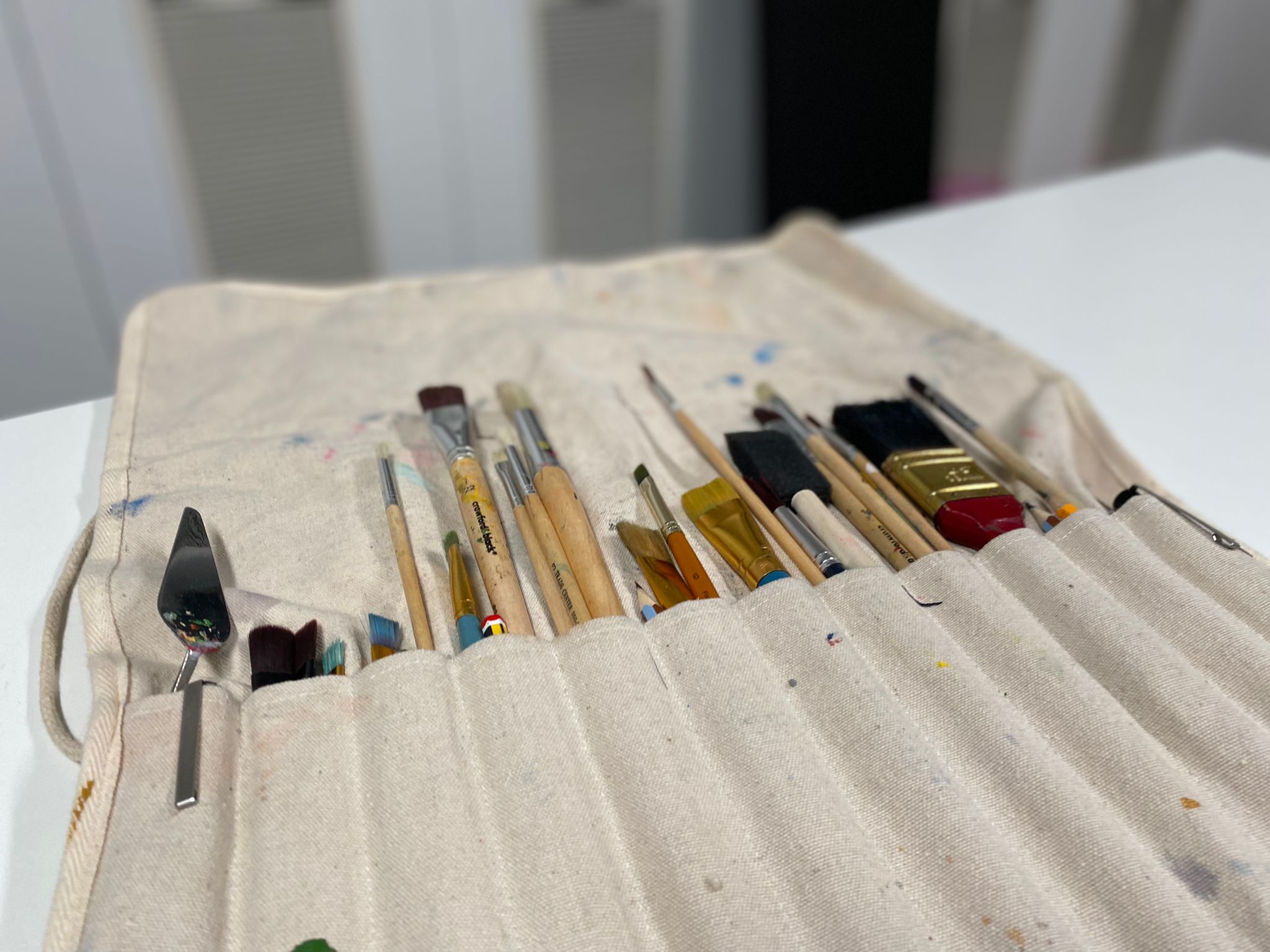
The next step is to find symbols known to the brain in the twists and turns of endless lines. Everyone finds something different here — a bird, a child, or the outlines of the shape of a country. Next, we trace the patterns of the symbols that the person saw, create a single drawing and paint it in different colours. When we finish, the participants can take home the finished picture. This activity not only helps to release our creativity, but also to fight stress’
Anna also believes that even the colours we see every day affect us: ‘Everything we surround ourselves with has a great impact on our well-being, emotions, and state. Even scientific studies show that when we look at something we like, especially when it comes to art, our serotonin levels in the brain rise and we feel better. Interior objects, buildings, and even the cup you drink your coffee from in the morning fill your soul. And your soul becomes more beautiful. It’s the same with music — what we ‘fill’ our ears with affects us. For example, industrial jazz, which includes grinding, is fashionable, but these sounds and vibrations have a bad effect on our bodies. It’s the same with art: the colours we surround ourselves with, what we see every day, fill and shape us. Think about it: what is the colour of your life?’
Ukrainian modernism. Kateryna and Anna
Many famous contemporary artists were inspired by the modernism of the early twentieth century. In turn, artists of the 1900s and 1930s created, using the trends of futurism, cubism, and avant-garde. These movements formed the basis and became a continuation of contemporary art. However, few people know that many of the brightest representatives of the early twentieth century have Ukrainian roots.
Kateryna: For example, Sonia Delaunay (1885-1979) was an artist and designer, the founder of the artistic movements of Orphism and Symbolism. Russians claim her as their own, as the modern Odesa region where she was born was part of the Russian Empire at the time. The French say that Sonya is their artist because she lived in France for most of her life. But the truth is that she was born in Ukraine.


Andy Warhol (1928-1987) was a painter, illustrator, sculptor, writer, producer, and film director. He is called an American, although few people know that his parents are from the Prešov region (Ukrainian ethnic territory, now part of Slovakia — Ed.) He became popular because he was able to establish a manufactory of art, that is, he did not create a single copy, but rather a few dozen or even a hundred copies. It became popular and, thanks to Andy, there is a pop art industry in the world.


Besides them, there is also David Burliuk (Ukrainian futurist artist, poet, art theorist, literary and art critic, and publisher. 1882-1967 — Ed.), who made a revolution in art, because he was one of the first to decide to paint not what he saw, but how he felt. David was born in the village of Semyrotivshchyna, modern-day Sumy region. He is called the ‘Ukrainian Dali’, referring to his eccentricity, as the artist went out with a painted horse on his cheek, dressed elegantly and brightly. Often, Russians call Burliuk a Russian artist, as the Symu region was part of the Tsarist Russia, and Americans call him an American artist because he used to live there. Although he considered himself a ‘Ukrainian of Cossack family’. This is also felt in his works because about a third of them are dedicated to the Cossacks. His paintings speak for him.


We have about a hundred such artists who were forced to leave the Russian Empire but kept their Ukrainian childhood in the art. This is manifested in prints, colours, and patterns that are very typical of the land in which they were born. Sonia Delaunay even has a painting where she is nostalgic, recalling her childhood in a Ukrainian village. In this way, our artists have ‘carried’ our culture to the world, and many people appropriate them without even realizing that they have Ukrainian roots.
Anna: The early 20th century was a difficult time not only for everything Ukrainian: language, culture, and publishing, but also for people. Can we be sure that the works or personalities of those who left would have been the same as we know them now? After all, after the creation of the Soviet Union, the despotic government not only destroyed our culture but also interfered in art, forcing artists to paint ‘to order’.
Kateryna: The contribution of Ukrainian modernists to world art is very underestimated. Whether we are talking about visual or graphic art, it all goes back to our artists: Sonia Delaunay, and Vasyl Kandinsky (painter, graphic artist, art theorist, considered the first abstractionist. 1866-1944 – Ed.), David Burliuk.


Where did they get it from? Obviously from Ukraine. If you look at our nature, it has bright colours — the Crimean and Carpathian Mountains, the desert steppes in the south, the sea. Or folk art — the way houses used to be painted, the way clay utensils were made… Both the colours and patterns of Ukrainian modernists contain all these components — in some places they captured it visually, contemplating nature and everyday life, and in others, it seemed to be genetically transmitted.
Ukrainian modernism under totalitarianism
The greatest development of Ukrainian modernism took place in the 1920s and 1930s. At the same time, this period was marked by many tragic historical events aimed, in particular, at the destruction of everything Ukrainian. Both the Russian Tsarist Empire and the Soviet Union were no different in nature – despite the great revolution and many promises, both regimes were totalitarian. Ukrainian artists were caught in the eye of the storm.
This could not but affect their work, because the only trend that was allowed by the new government was ‘socialist realism’, and for their creativity, they were persecuted, exiled, and executed.
Kateryna: Definitely, totalitarian regimes did not pass by Ukrainian modernists either. The situation was such that artists had two options: to succumb to the new regulations or to resist them. If you look at the works of Ukrainian modernists, you will see that some of them were painted ‘to order’ — this includes the use of the red colour of propaganda, newspaper headlines and fonts approved by the Soviet authorities. We cannot condemn them, because they could have been executed for disobedience.
Some did not agree with this. For example, Kazymyr Malevych refused to perform as Soviet authority command (the artist was one of those who actively resisted the regime. The phrase ‘Where there is a hammer and sickle (the main symbols of Soviet Union, there is death and famine’ (referring to the Holodomor) belongs to Malevych — Ed.)) He was repressed, forced to hide, and planned to escape to Western Europe, but it was too late because he was arrested by the Enkavedists (a secret organization that was created by Soviet authority, The main target of NKVD was execution for those who disagreed with government — Ed.) on suspicion of espionage and formalism. He died in terrible poverty, and his grave was found later, in a collective farm field. Malevich was incredibly talented and he was an author of ‘Suprematism’ (the idea that true art should reflect emotional and spiritual aspects, not just depict objects or scenes — Ed.). Malevich’s key work within Suprematism is Black Square (1915).


Many of those who eventually agreed to ‘cooperate’ with the Soviet authorities are now unknown to us because we do not consider their works in the context of creativity, but rather as propaganda. That’s why we distinguish between Soviet modernism, which includes mosaics, sculptures, architecture, and paintings created under the pressure of the system, and Ukrainian modernism, a separate art movement that existed despite all the historical events, in parallel with them.
Anna: I believe that Malevich, like many artists of that time, had a high sensitivity and intuition. Now, thanks to modern technology, we have discovered that there are two more paintings hidden under Malevich’s Black Square. And many art historians say that this symbolized that he felt that difficult, dark times were coming. Malevich himself interpreted his work as a symbol of the coming ‘black period’, referring to the Soviet era. This painting was most likely painted in 1915, and after that, there were mass arrests of Ukrainian intellectuals, exile or forced migration.
I believe that we cannot devalue the artists who stayed in the Soviet Union and collaborated with the authorities; their works are also valuable for art because they reflected the reality of that time. If you look at the paintings of the 20s and 30s, you will understand how difficult those times were, because even the colours are very dark, people are depicted as poor, unhappy or disabled.

Even if you compare the art of Western Europe and Ukraine at the same time, they are very different. And this is understandable — the art of Ukrainian modernism could not be sophisticated, bright, and inspired. The times and circumstances were different.
A common dream
Anna and Kateryna dream of owning their own art space in London, which would include a gallery, a creative space and even a bar with drinks.
Kateryna: I see it as an art space with a contemporary art exhibition, music events, poetry, and sometimes a DJ, with a lot of art, paintings, poetry, music and various workshops.
Anna: For me, it’s important that you can learn something new there, like making ceramics, painting, or mosaics. It is also essential to exhibit paintings by Ukrainian artists and bring creative people together to create an atmosphere of friendship and support. And, of course, to drink premium coffee”.

In addition, they dream that the art space will have a place for lectures about Ukrainian modernism and art in general.
Kateryna: Boris Voznytskyi once managed to get the Louvre to exhibit the works of the brilliant sculptor Pinsel. In 2012, it was an incredible achievement. Everyone goes to see the works of Michelangelo, da Vinci, Raphael, or Monet, but for some reason, there is no tendency to look at Ukrainian artists. And it has nothing to do with the fact that they are less interesting or talented. It’s just that there is less talk about our artists.
Anna: For paintings by Ukrainian artists to sell for millions, people need to be made aware of their value. After all, the price often depends on many factors, such as where the artist studied, was formed, and was inspired. It even matters where their paintings were previously exhibited. Therefore, for Ukrainian artists to be popular, they must be spoken about. I would like to see our artists’ paintings exhibited in the future art space, thus promoting Ukrainian art.
The author — Rostyslava Martyniuk
The editor of Ukrainian text — Anastasia Zanusdanova
The editor of English text — Helen Lewis
Leave a Reply