

The Ukrainian Youth Association – CYM (SUM – pronounced ‘soom’) originated as an underground organisation in 1925, in response to the defeat in the national liberation struggle of 1918–1920. At that time, Ukraine was squeezed between four states: Bolshevik Russia, Poland, Romania, and Czechoslovakia, and was likely to become part of another country. However, SUM members disagreed with this and wanted Ukraine to be a free, independent state. Therefore, they united around this idea.
SUM existed until 1929, when the Soviet secret services exposed it. In 1930, most of its members were convicted and sent to concentration camps, from which many never returned. Mykola Pavliushkov, the first head of the organisation, was executed in Sandarmokh, Russia.
At that point, SUM ceased to exist in Ukraine for a short time, but after the end of World War II, in 1946, it was revived by Ukrainian youth who were in camps in the German, French and American zones. They could not return to their homeland because of Stalin’s regime, but decided to preserve a piece of Ukraine abroad.
The Ukrainian youth community in Great Britain was revived in 1948, with Tarasivka, a former American military base purchased and restored by the Ukrainian diaspora in 1964, becoming its centre. Tarasivka is located in Derbyshire, where summer training camps are still held today. In July 2025, the 100th anniversary of the SUM was celebrated here.
Tarasivka is nestled on one of the side streets of the village of Weston-on-Trent, in the heart of England. It is hard to miss, as the Ukrainian flag can be seen waving from a distance, and the SUM coat of arms, which closely resembles the coat of arms of Ukraine, is proudly displayed. Inscribed in Cyrillic are the words ‘Tarasivka. Centre of Ukrainian Youth’.
 On the premises, a monument commemorates those who have died for the freedom of Ukraine, spanning from national liberation movements to the present day. Alongside the stretched tents, there are several brick buildings.
Next to these structures, a fair showcases products related to Ukraine, with the enticing aromas of street food and Crimean chebureki wafting through the air. Two stages feature Ukrainian songs, with members of the diaspora performing their talents one after another.
The crowd is adorned in a sea of embroidered shirts, reflecting both ancient and modern styles. You can hear Ukrainian spoken in a way reminiscent of the last century.
Tarasivka is celebrating the 100th anniversary of the founding of the Ukrainian Youth Association. However, the most significant part of the celebration occurs not on stage or at the fair, but in a small room marked by a piece of white office paper hanging on the wall with the word ‘Exhibition’ written in colorful marker.
Inside, stands display old photographs of gatherings featuring individuals who are no longer alive, along with posters from the mid-20th century adorning the walls.


An iron bunk bed, a relic from the days of soldiers’ barracks, sits in the room, accompanied by a suitcase and a pillow stuffed with hay. Adjacent to the bed is a wooden wardrobe and a gramophone. In the centre of the room hangs a photo of Mykola Pavliushkov.

Next to each stand, a member of the Ukrainian Youth Association is ready to share the century-old history of the organization.
Volodymyr Pavliuk is the former head of the SUM branch in London and the regional administration in Great Britain, which was responsible for Tarasivka. He is the son of a soldier in the Halychyna Division of the Waffen-SS, who was captured in Italy and brought to Great Britain. Volodymyr now heads the London branch of the Union of Ukrainians in Great Britain.
“When the SUM was revived in Germany in 1946, it was a remarkable moment. There are still old photos from the gathering showing SUM members standing in their old uniforms – white shirts, dark ties and trousers. Later, when Ukrainian youth were able to obtain documents, they began to travel to other countries: the United States, Canada and the United Kingdom.
Some went in search of a better life and stayed there. That is how they spread the story of the revival of SUM around the world.”
By 1948, there were already 60 branches in various cities in the United Kingdom, mainly consisting of young people who had left Ukraine during the Second World War. The maximum number of people in one branch was 60–70. SUM worked very closely with Plast (founded in 1929) and the Ukrainian Association in the United Kingdom (founded in 1945).
“Their main goal was to survive as an ethnic group, to preserve their traditions, customs, language and culture. Many young Ukrainians married foreigners, had children, and they wanted to pass on something of their heritage to their children.
Many of them had been imprisoned for their active political activities during World War II, were associated with the Ukrainian Insurgent Army, which was forbidden at that time, or had been deported to forced labour camps as so-called ostarbeiters. They were hunted down in the Soviet Union by the NKVD, but also by the Polish security services, so it was dangerous to return to Ukraine.
Nowadays, the active members of SUM are mainly descendants of those diaspora members.
In 1964, immigrants from Ukraine also managed to raise funds to buy three premises in the United Kingdom. The first premises were former American military bases abandoned after World War II, where Ukrainian youth gatherings and summer camps for children were held.
The premises were named Tarasivka in honour of Taras Shevchenko, a Ukrainian poet and writer. “As soon as our people found out that the premises in Derbyshire were for sale, they decided to buy them because the location was centrally located in the middle of the country for those who lived in Scotland and Wales to travel there.
Those who lived nearby – in Coventry, or Derby for example – came to equip the premises: they cleaned, repaired, made furniture from boards, and cleaned up the surrounding area.”
Two other premises served as shelters: one was located in the town of Chiddingford, and the other was called Kobzarivka and was located near Tarasivka.
 “After World War II, there were many former soldiers of the Waffen-SS Division “Galicia” in Great Britain. Their status was uncertain because they were practically part of the enemy Nazi army. The authorities wanted to send them back without providing these people with documents. They also did not receive any medical care. But the Ukrainian diaspora wrote letters and appeals to parliament. It was agreed that the diaspora would take responsibility for them. Donations were collected, and a house was bought in Chiddingfold, which was equipped as a shelter and cared for people with physical or mental injuries.
Those who cared for the wounded lived there permanently and received salaries paid for by contributions from the Ukrainian diaspora.
Our people worked very hard and gave a large part of their earnings to create and maintain these facilities.
Over time, maintaining the shelters became impractical, and the premises were sold. Now the Kobzarivka premises are privately owned. However, near the church, there is a cemetery with many graves bearing Ukrainian names, as this is where the shelter’s residents were buried.
Near the exhibition hall, I met two elderly women: Irina Dobrovolska and Maria Finiv. They are too young to have been involved in the creation of Tarasivka, but they attended summer training camps. That is where they met.
Maria:
“My father was a soldier in the SS Division Galician, originally from the Ivano-Frankivsk region. My mother is Italian. They met in England, in the Tattershall camp in Lincolnshire, when my father was brought there as a prisoner of war during the Second World War. His regiment was defeated near Rimini, Italy, and my mother was working in the same camp.
When the time came, they were released and moved to Derbyshire, because there was already a Ukrainian community there.
Maria was in the first camp held in Tarasivka; before that, she participated in camps in Chiddingfold, for the first time in 1958. She shares that her husband, born in 1948, was at the very first SUM training camp in 1954.
“We had different activities at the camps – history, SUM studies, dancing, singing.
Most of the songs we learned then were those of the Ukrainian Insurgent Army. We were also taught to march and embroider. Back then, we had educational camps, but now they are more recreational.”
Iryna shares that she first went to the camp in Tarasivka in 1967, having previously only been to camps in Scotland.
‘And that’s where we met,’ the women say in unison.
Iryna’s parents are Ukrainian; her mother is from the Ivano-Frankivsk region, and her father is from the Ternopil region. They met in a labour camp where the Germans had taken them.
“My mother wanted to return to Ukraine after the war, but my father told her, ‘Come to your senses, if we get on that train, it could be hazardous. ’ And so they didn’t go.”
While we are talking to Iryna and Maria, we are approached by Lidia Deremenda, whose father, Yaroslav, was the head of the Ukrainian Youth Association (SUM) from 1950 and deputy head of the world administration in 1964, when Tarasivka was purchased.

“My father was from Buchach and fought in the SS Galician Division. He was in Rimini when World War II ended, and that’s how he ended up in England. He lived in a refugee camp there. My mother was from Lviv. She was a child when she and her mother, my grandmother, were taken to Germany by the Nazis as forced labourers. When Tarasivka was bought, I was 10 years old and practically grew up here. My mother worked in Kobzarivka, looking after the wounded, and my father headed the SUM. He was one of the initiators of the purchase of Tarasivka, which was bought for £33,000, equivalent to about a million pounds today.
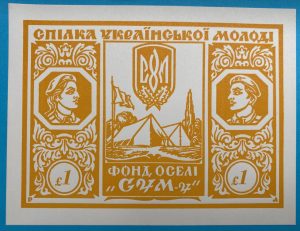
At that time, you could earn £5–7 a month working at the factory. To raise funds, we sold tokens of various denominations in exchange for donations to the Tarasivka fund. Graphic artist Robert Lisovsky designed the tokens.
“I remember those times when there could be up to 600 people in the camp. The first thing we did was to stuff our bedding: a piece of cloth sewn into a pillowcase, which we filled with hay, and we had a pillow. A typical day in the camp for children looked like this: morning exercises, then communal prayer and breakfast, followed by lessons, for example, geography and Ukrainian history. After lunch, we could choose which classes to attend: singing, embroidery, swimming (there used to be a swimming pool in Tarasivka, but it has now been closed). After that, we had free time, and then evening prayers and quiet time.
According to Lydia, the post-war diaspora felt fear for a long time due to the uncertain situation – after all, it was dangerous to return to the Soviet Union for fear of being declared foreign spies, convicted, or even executed. At the same time, they had an uncertain status in the United Kingdom. Despite this, the Ukrainian diaspora was active – they organised camps, got together and went to the seaside, there were fairs and church visits.
“They lived ‘out of suitcases’ because they did not have the right to choose their place of residence independently. The state sent them to work, mainly in textile, canning or brick factories, and Ukrainians also worked in mines and on farms.
But they still organised themselves into small groups in their local areas and tried to preserve Ukrainian culture and traditions on their own. They also taught their children to be Ukrainians, even far from their homeland.”
Alex Kosmirak, deputy head of the regional council of the Ukrainian Youth Association, joins the conversation later.

He says that similar events are held every year, the only difference being that this year the organisation is celebrating its 100th anniversary:
“There are now 14 SUM branches in the UK, and we all get together every year to honour our organisation. This is not a closed event: anyone can come, not just SUM members. But this year we have a record number of visitors. Some people said that they have been living in England for 25 years and came to Tarasivka for the first time this year.”
Every year, SUM chooses a slogan for the celebration. For example, last year it was ‘Evil will perish and truth will prevail,’ in 2022 it was ‘Burn with nowadays’ fire,’ in 2019 it was ‘Unity is our strength,’ and in 2018 it was ‘The goal of freedom is to make good.’
This year, no slogan was chosen because the celebration itself was unique due to the anniversary. Alex says that the most important thing for them is the atmosphere: “The purpose of such events is not only to spread Ukrainian culture, but also to ensure that Ukrainians in the UK continue to carry on our traditions and language and that everyone feels at home.
Usually, the festivities begin on Friday evening, when everyone arrives early and sets up tents on the Tarasivka premises. Saturday is the official opening, at the monument to those who died for Ukraine, followed by concerts, music, dance groups, and a fair in the afternoon. This year the celebration was much bigger: on Friday evening, there was a DJ, and at the official opening the mayor of Derby and priests came to pray for those SUM members who died in the war against Russia. An additional stage was also set up on the street for music bands.


In addition to the annual celebration, SUM also engages in educational and community work, such as giving lectures on Ukrainian history or famous figures, teaching Christmas carols at Christmas, and organising Easter egg painting workshops at Easter. Sometimes they hold sports events, such as water sports classes. Creative groups, such as dance and music performers take part in festivals and concerts to showcase Ukrainian culture to the local community. Much of the organisation’s activities are related to the war in Ukraine.
“In winter, we collect warm clothes for SUM members who are currently fighting on the front lines to keep them warm. During the camps, we have classes where young people write letters with wishes to the soldiers. From time to time, we organise meetings to collect donations or purchase necessary equipment and send it to the Armed Forces of Ukraine. Many of our members, work on the information front, actively spreading the truth about the war in Ukraine.”
SUM also holds annual summer camps for children whose parents are members of the organisation. All SUM members are divided into five age categories: the youngest (3–6 years old), followed by younger youth (7–11 years old) and older youth (12–17 years old). Then there are the druzhynnyky (18–49 years old) and seniors (50+).

Children and teenagers aged 3 to 17 participate in the camps. The members volunteer to equip the camp and prepare the premises for the participants’ arrival, and later become mentors for the youth. The seniors are advisors to the Druzhynnyky. The camps can be educational, recreational or sports camps.
“At sports camps, we play volleyball, football, dance Zumba, ride bicycles or canoes, go rock climbing, or go on long hikes. Here, we focus more on the health and wellbeing of the participants. Educational and recreational camps are those where participants learn about Ukrainian cultural heritage, traditions, rituals, celebrations, and important dates in Ukraine. But here, too, there are various sports activities where we play games, enjoy music, learn and sing songs, and learn folk dances. We call the very first camp, where volunteers gather to prepare everything for the participants’ arrival, the technical camp.
According to Alex, to become a member of SUM in the UK, you just need to find a branch in your city and express your desire to join. If there isn’t one, you can create one.
“Our website has the addresses of all existing branches. However, we have experience in creating, or sometimes reviving, a branch, as evidenced by our recent approach from people in Edinburgh. They were newly arrived Ukrainians who were already familiar with the activities of SUM in Ukraine. They contacted the head of the administration, and we helped them set up a new branch. We are always looking for new people, and we are thrilled when people contact us to join the organisation. There are no restrictions: no age, religious or political affiliation, but it is vital that the person is like-minded, wants to promote Ukrainian culture to the world, and has a desire to volunteer.
Text and photos: Rosa Martyniuk
Editor: Helen Lewis
Some photos were taken at SUM website
Leave a Reply